Naila Marbal still can’t go into the bathroom alone. Two months after the ground split open beneath La Guaira, she says the fear hasn’t caught up with the calendar yet. “When I’m in the bathroom, I feel like it’s moving,” she told our team. “And it’s horrible.” She asks her mother to come with her every time.
That’s what Venezuela earthquake recovery looks like up close. It’s slower than the headlines suggest, and for families like Naila’s, it’s far from finished. Here’s what happened to her that day, how ADRA moved in to help, and why—two months on—another family, Yasmin’s, is still waiting for a home of their own.
Naila’s Story: The Night the Ground Split Open
On June 24, 2026, at 6:04 p.m., a magnitude 7.2 earthquake struck Yaracuy state in northern Venezuela. Thirty-nine seconds later, a magnitude 7.5 mainshock hit nearby. Naila was 24, pregnant, and lying down at her mother’s flat when her phone started ringing without stopping.

She ran for the stairs. By the time she reached the bottom step, the floor was already moving.
“I saw my mum falling over and the fridge coming crashing down on top of her,” she said. Her mother pushed Naila’s youngest daughter clear. Naila grabbed her older daughter and held on as the quake threw them both into the living room, into a wooden table, onto the floor. “This is falling on us,” she remembers telling her daughter. “It’s falling on us, and we’re going to die, but we’re together.”
They got out. The building didn’t fully collapse, but Naila says it seemed seconds from coming down completely.
She hasn’t lost her home to the earthquake. Her sisters lost everything. One of them escaped her flat just five seconds before it exploded—gas cylinders that had recently been filled went up after the quake hit. Naila’s own children weren’t hurt, but nephews were pulled from rubble after being trapped for a day. She says they’ve started treating the rescue itself like a game, telling her “hide-and-seek’s over now,” because that’s the only way they know how to talk about it.
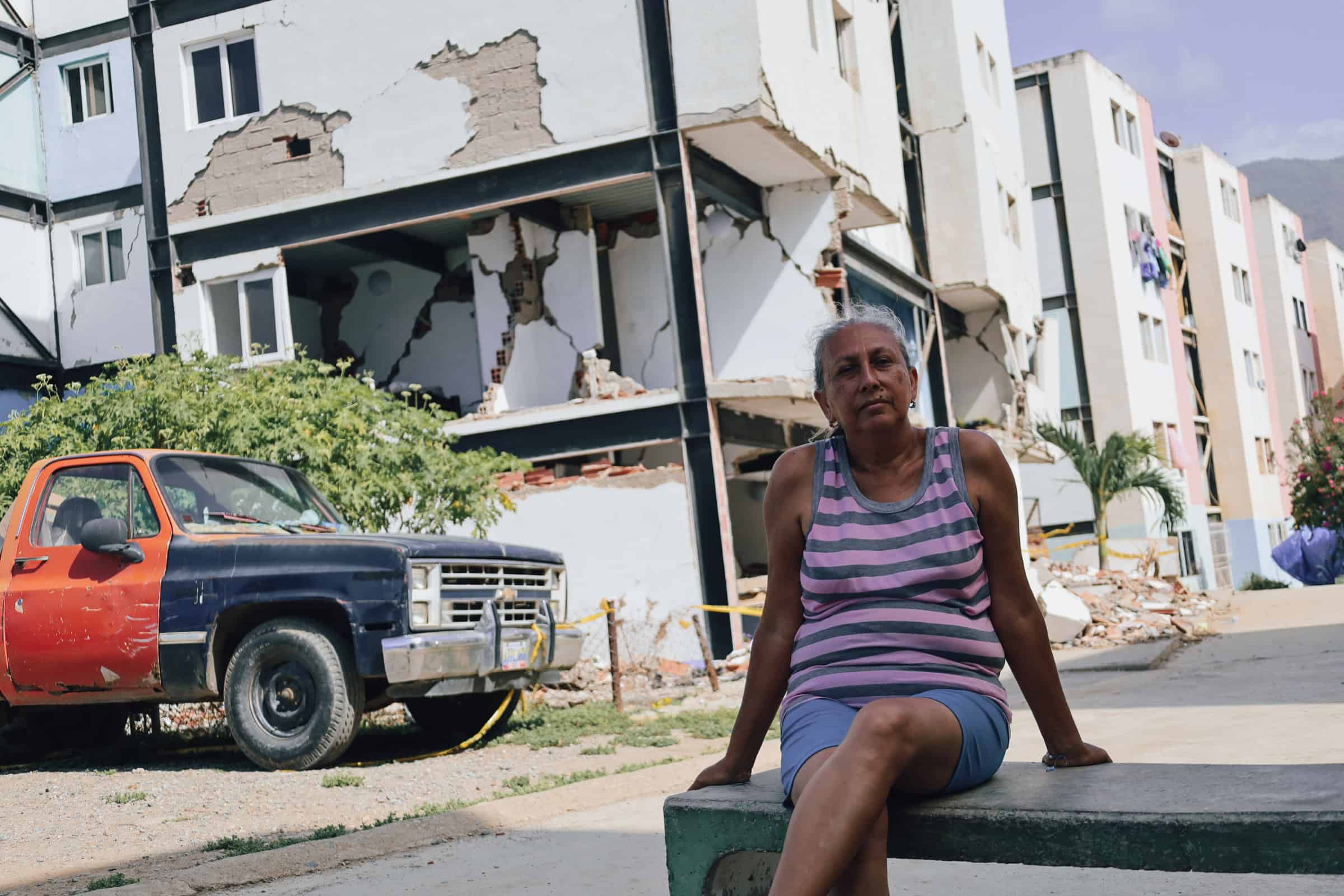
Naila’s experience was one small piece of something much larger. The worst damage landed on the coast: in La Guaira state, an estimated 69,400 buildings sustained damage or collapsed outright, and Caracas, roughly 20 miles away, took heavy structural damage too. Satellite radar data from NASA’s NISAR mission later confirmed the ground itself shifted most severely in exactly these two places. By August, reporting placed the death toll above 6,300, with search and recovery work still ongoing and tens of thousands of people still unaccounted for. More than a thousand aftershocks followed in the weeks after, including one on June 26 that collapsed a bridge connecting the Caraballeda area to the rest of La Guaira.
Naila holds a smaller number in her head than any of those. In her own community, she says, 375 people didn’t survive the first tremor. That figure is her account of her town, not a national tally, but it’s the number she carries.
Life in the Tent, Two Months Later
What Naila has held onto since is smaller and stranger than the earthquake itself. It’s a tent, given to her by young men living nearby a few days after the quake, in a camp of six families in La Guaira. She’s stayed there alone with her daughters ever since. Her reasoning is practical, not sentimental: staying at her mother’s flat means she won’t be registered anywhere for housing help, and she needs to be registered somewhere to have any shot at getting a home of her own. “I need a home for my daughter,” she said. “I’d rather go to a shelter, or somewhere where I know they’re going to have to register me.”

What she says she needs most, right now, isn’t a home. It’s food and water. “What we need most right now, actually, what everyone needs is food—dry food,” she said. Cooked meals spoil fast when nobody has a working freezer, and tap water isn’t safe to drink with the infrastructure still damaged.
How ADRA Responded
Naila’s community wasn’t left to face this alone. ADRA runs a National Emergency Management Plan in every country office, Venezuela included, built specifically so teams don’t have to improvise a response from zero when disaster hits. Trained Emergency Response Teams, made up of staff, volunteers and church partners, can deploy locally or internationally when a local office gets overwhelmed. You can read more about how ADRA’s emergency preparedness model works.
On the ground in Venezuela, that response has been led by people like Edinson Bohorquez, ADRA Venezuela’s CSR Manager, and Rafael Benitez, the agency’s Executive Director in the country.
“We have assisted exactly 3,007 families,” Edinson said, of ADRA’s tally so far. The first steps ADRA took after the earthquake were about connection, not just supplies.
Before distributing a single kit, teams established contact with local authorities and other NGOs working the same ground, so that food didn’t pile up in one neighborhood while hygiene kits and clean water never made it to the next one over. “Those visits to the communities, seeing what is needed, meeting with community leaders, spending time with families and seeing their needs. That is the starting point for all the help we provide,” Edinson said.

Rafael frames the early weeks in plainer terms. “At the moment we are in phase 1,” he said, in a late-July interview, “and in phase 1 we have reached 3,000 families, totalling 12,000 individuals.” That phase ran on a $100,000 grant, which he says has already been fully disbursed.

Phase 2, running through December, was just getting underway at the time of that interview. Rafael frames the overall program as five major projects in total, covering WASH and sanitation, protection, and food security, though he names and details four of them specifically:
- NEM grant: A $100,000 grant, fully disbursed as of late July.
- ADRA Network Project: $600,000 for 6,000 hygiene kits, still in progress as of late July.
- LDS-funded food program: 5,000 food kits, expected to begin the following month.
- Alinea Project (with the US State Department, World Vision, and Aid International): A long-term effort reaching around 18,000 households with emergency kits, family kits, menstrual hygiene kits, and WASH supplies, running through December.
None of that erases where things actually stand for families. “We are emerging from the emergency phase,” Edinson said. “But the early recovery phase is a very broad one, and it is only just beginning.” Families are stabilizing. They aren’t rebuilding yet.
Want to see how this compares to ADRA’s earlier response on the ground in Ciudad Caribia? Read Oneida’s story from the first weeks after the quake.
Yasmin’s Story: Waiting for a Home
Yasmin Gómez is 56. Her own house survived. Her sister’s didn’t.
She’s spent weeks clearing out what’s left of her sister Tatiana’s collapsed home in Suma, while Tatiana herself has been moving between a tent and shelters, trying to find somewhere safe to stay. Tatiana has dermatitis severe enough that direct sun puts her at real risk, which rules out most of the outdoor camps still standing.

“What she most needs is her home,” Yasmin said, relaying her sister’s words during the interview after Tatiana’s own voice didn’t come through clearly on the recording. Tatiana had worked for years as a teacher and did bookkeeping for another woman in the community, all while raising two daughters, both now in university, one finishing a degree in psychology this December and the other with a semester of accounting left. She’d told Yasmin she was waiting for her daughters to finish so she could finally rest in the home she’d worked her whole life to keep. Instead, the earthquake took the house.
For Tatiana and Yasmin, the greatest need isn’t food or water, the way it was for Naila. It’s four walls. Yasmin isn’t asking for anything grand on her own behalf. She sells ice cream for a living, and by her own account it’s Tatiana who’s spent a lifetime sharing what little she had, inviting Yasmin over for meals even in years when there was barely enough to go around. Now Yasmin is the one asking, on Tatiana’s behalf, for something as basic as a home.
Two months after the earthquake, with ADRA’s five-project response still running through December, Yasmin’s story is a reminder of what “recovery” actually requires: not just emergency kits and food, but the slow, individual work of getting one family back into a house.
What Families Still Need
Ask the people living it, and the list gets specific fast:
Dry food that doesn’t need refrigeration and won’t spoil in a shared tent.
Safe drinking water, since damaged infrastructure has made tap water unreliable across parts of La Guaira.
Real shelter, not a tent or a shared bunk—something that counts as a home, the way Tatiana describes it.
Reliable access to medicine for people with existing health conditions. Yasmin says it took real effort to get Tatiana’s medication to her once she was displaced.
Psychosocial support, especially for children. Naila describes nephews pulled from rubble after a day who now treat the memory of being rescued like a game.
Present, Not Just Ready
ADRA had systems in place before June 24, moved within days through the weeks that followed, and it’s still working now, months later, on the slower work of getting a pregnant mother out of a tent and getting a woman with acute dermatitis, like Yasmin’s sister Tatiana, somewhere she can finally rest out of the sun.

Disaster recovery in places like Venezuela isn’t a moment. It’s what happens in the months after the initial event. The ongoing support of people like you is what makes that work possible. To learn more about our current emergency response work, click the link below.
Support ADRA’s ongoing emergency response work →
Frequently Asked Questions
What caused the Venezuela earthquakes in 2026?
A magnitude 7.2 foreshock and a magnitude 7.5 mainshock struck Yaracuy state, in northern Venezuela, 39 seconds apart on June 24, 2026. Coastal areas including La Guaira and Caracas took the worst damage, even though the quakes were centered further inland. Together, they became the strongest earthquakes recorded in the country in more than 100 years.
How many people were affected by the Venezuela earthquake?
Humanitarian estimates put the death toll above 6,300 as of August 2026, with search and recovery work still ongoing. Tens of thousands more were injured or displaced, and La Guaira state was hit hardest of all.
How is ADRA responding to the Venezuela earthquake?
ADRA Venezuela activated its emergency plan within days, reaching over 3,000 families in its first response phase. Rafael Benitez, the country director, describes a five-project program covering food, water, hygiene, and protection services running through December 2026.
Is Venezuela earthquake recovery still ongoing?
Yes. ADRA staff describe the country as being in an early recovery phase, not full recovery. Thousands of families, including Naila’s and Yasmin’s sister Tatiana’s, still live in tents or temporary shelter two months after the quake.
How can I help Venezuela earthquake survivors?
Financial gifts let ADRA buy exactly what’s needed in-country, whether that’s food kits, water purification supplies, or shelter materials. You can support the ongoing response through ADRA’s emergency response fund.