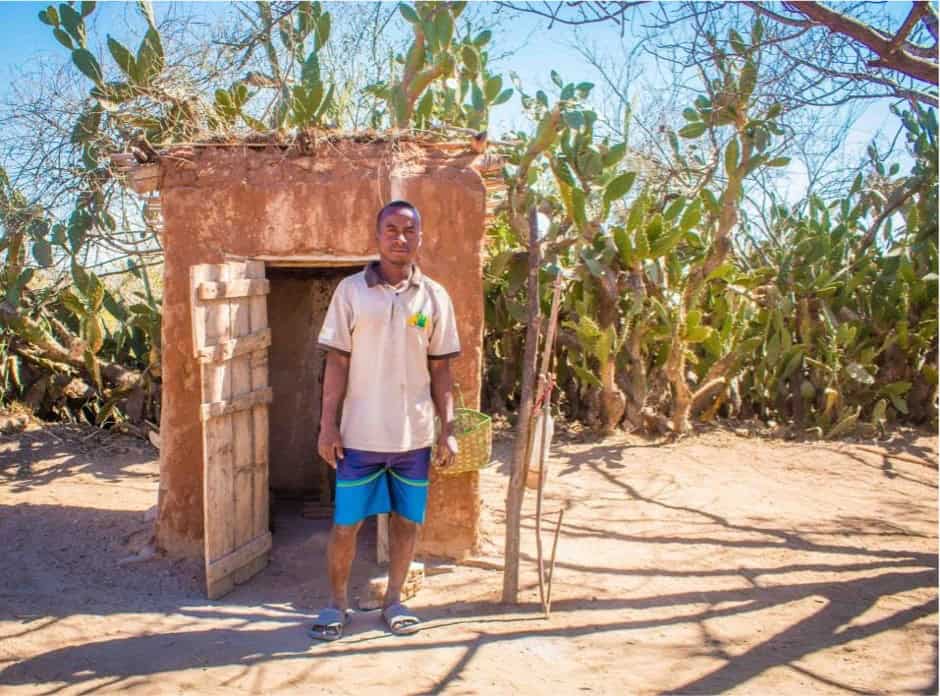
Il n'a pas été facile de changer des croyances de longue date dans la communauté de Mandahazo, dans la commune de Lazarivo. De nombreuses personnes pensaient que les latrines étaient liées à des esprits maléfiques susceptibles de nuire aux enfants, ce qui faisait de la défécation à l'air libre une pratique courante.
“Convaincre les gens d'utiliser des latrines a été très difficile. Lorsqu'on leur demandait pourquoi ils déféquaient à l'air libre, ils nous répondaient que garder les excréments entre quatre murs était tabou et attirait le diable”, explique Lambo Jean Mahafetsy, agent de santé communautaire.
Avant le projet ASOTRY, les décès liés à la diarrhée étaient fréquents. “Avant, le village était très sale. Dans de nombreux endroits du village, il y avait toujours un risque de marcher sur des excréments. Pourtant, l'eau que nous buvions n'était pas loin de l'endroit où nous déféquions. C'est pourquoi tant d'enfants mouraient de diarrhée”, explique Jean Rabemananjara, responsable de l'hygiène.
Pour y remédier, le projet ASOTRY, par l'intermédiaire d'Action Intercoopération Madagascar (AIM), a introduit des activités d'assainissement et d'hygiène, notamment l'assainissement total piloté par la communauté (Community-Led Total Sanitation - CLTS).
Les équipes du projet ont travaillé en étroite collaboration avec la communauté pour la sensibiliser aux dangers de la défécation à l'air libre. “Nous les emmenons aux endroits où ils défèquent, puis nous leur demandons s'ils aimeraient manger à côté de l'endroit, et ils commencent à être dégoûtés. Nous leur expliquons alors que les mouches transportent les microbes de leurs excréments vers leur nourriture, ce qui est à l'origine de maladies telles que la diarrhée qui a tué leurs enfants... c'est ainsi que nous les avons convaincus”, explique Lambo Jean.
Au fil du temps, les attitudes ont commencé à changer. Les familles ont commencé à construire des latrines et à nettoyer les zones de défécation à l'air libre, dont certaines ont ensuite été transformées en champs de manioc.
“Certains projets avaient déjà construit des latrines, mais personne ne les avait utilisées. C'est ASOTRY qui nous a convaincus d'abandonner nos mauvaises pratiques... Les maladies commencent à diminuer “, explique Lamboharimana Gilbert, un autre agent de santé communautaire.
La construction des latrines n'a pas toujours été facile. “Nous avons rencontré quelques difficultés lors de la construction des latrines, parce que nous vivons sur un terrain rocailleux. Parfois, nous ne creusons que 50 cm et nous heurtons un rocher. Mais cela ne nous a pas découragés. Finalement, notre village dispose aujourd'hui d'une quarantaine de latrines au total”, explique Lamboharimana Gilbert.