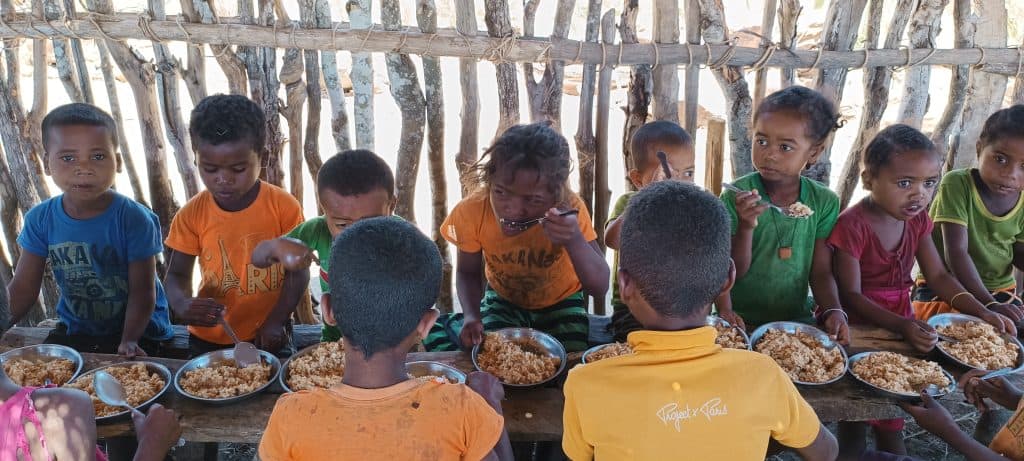
A war breaks out three thousand miles from home. Six months later, a mother in southern Madagascar can’t afford maize.
That’s not a coincidence. It’s how the global food system works.
Modern food production is an interconnected network, not a set of separate local markets. Fertilizer feeds the crop, fuel ships it, a port loads it, a currency prices it at the other end. When one link in that network jams, whether that’s a drought, a blockade, or a currency in freefall, the strain doesn’t stay put. It moves down the chain until it shows up as an empty shelf or a price a family can’t cover, thousands of miles from where the trouble started.
This is exactly why school feeding programs have become one of the most effective tools against hunger anywhere in the world. This post walks through what actually happens when that system breaks, what hunger does to a growing child, and how a single dailymeal at school can interrupt the damage before it becomes permanent.
What Happened in 2022: Three Crises At Once
You don’t need a hypothetical to understand this. You need 2022.
That year, three separate shocks hit the global food system at nearly the same moment, and each one made the others worse.
A Historic Drought
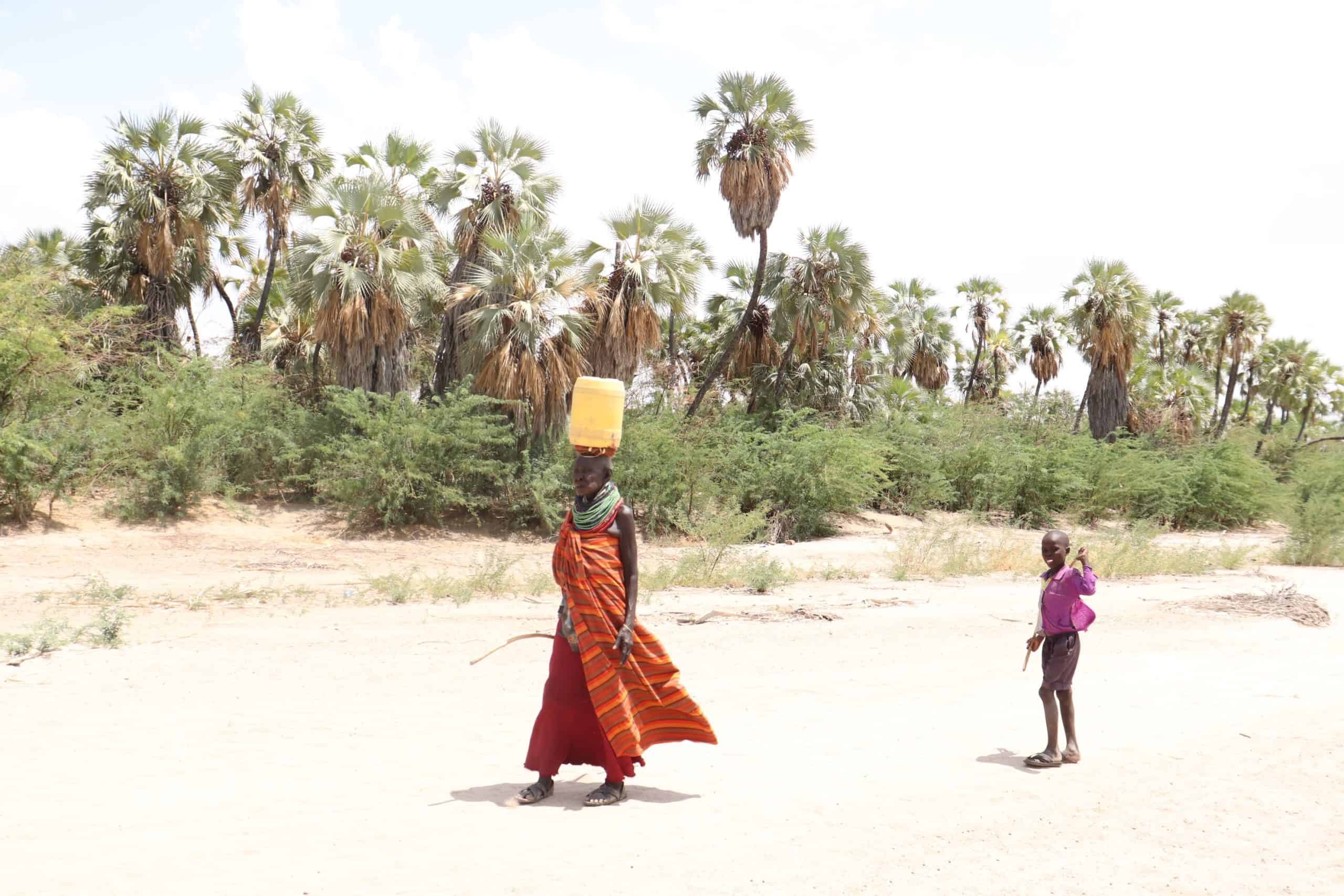
The Horn of Africa endured its fifth consecutive failed rainy season—the longest drought on record for the region. Farming families across Ethiopia, Kenya, and Somalia had no harvest to fall back on. At the same time, droughts cut grain yields across the U.S. Midwest and Europe, shrinking the global supply just as demand kept climbing.

A Global Economic Shock
Post-pandemic supply chains were already strained before any of this started. Shipping costs and fertilizer prices spiked, and smallholder farmers got priced out of the basic inputs they needed just to plant. A farmer in Malawi who normally bought importedfertilizer to survive a dry season suddenly couldn’t afford it. Crops were in trouble before a single seed hit the ground.
A War That Broke the Breadbasket
Russia’s invasion of Ukraine blockaded Black Sea ports almost overnight. Together, the two countries had supplied close to a third of the world’s wheat exports, and millions of tons of grain got trapped behind the blockade. Global wheat prices jumped sharply within weeks, and countries that relied on the region for grain felt it first and hardest.
None of these crises stayed in its lane. A war in Eastern Europe, a supply chain already under strain, and a drought that wouldn’t break—together, they meant a family thousands of miles from any battlefield suddenly couldn’t afford a bowl of maize.
What Hunger Actually Does to a Child

We tend to talk about hunger in statistics. It isn’t one. It’s biology, and it plays out differently depending on who’s affected.
When an adult goes without enough food, the body burns through fat reserves. It’s painful. It’s also usually reversible once food returns.
A child’s body doesn’t have that luxury.
What is stunting, and why does it matter? Stunting happens when chronic malnutrition forces a child’s body into survival mode during the years when their brain is developing fastest. The body redirects energy to keep the heart and lungs running, at the cost of building bone and brain tissue. The physical result is a child too short for their age. The deeper cost—permanently reduced cognitive capacity—usually goes unseen. As of the most recent global data, 150.2 million children under five are affected worldwide, according to the 2025 UNICEF-WHO-World Bank Joint Child Malnutrition Estimates.
That’s not a number you can undo with a good meal six months later. The damage happens in a window that doesn’t reopen.
How Hunger Empties the Classroom
A hungry child can’t learn. That much is obvious. What’s less obvious is how quickly hunger empties an entire school.
When food gets scarce, families make impossible trade-offs. Kids get pulled from class to work the fields, scavenge for food, or walk long distances for water. Some are simply too weak to make the walk to school at all.
You can build the best school in a region—good teachers, real textbooks, a solid roof—and it won’t matter if the children inside it are malnourished. Basic biological needs come before anything else, every time. This is how poverty passes from one generation to the next: a supply chain breaks somewhere far away, a child’s development stalls, school stops being possible, and the door to a different economic future closes quietly.
How School Feeding Programs Break the Cycle
Fixing a global supply chain that spans dozens of countries isn’t realistic for any single organization. So ADRA doesn’t try. Instead, the strategy is to build something smaller and far more resilient, starting at the one place where the damage is happening: the school.

What is a school feeding program?
A school feeding program provides children with a guaranteed, nutritious meal at school, usually daily. It’s a simple idea with a compounding effect—it stops the biological damage of malnutrition, gives parents a direct incentive to keep their children enrolled, and turns the classroom into the front line of a community’s recovery.
The Immediate Effect: Halting the Damage
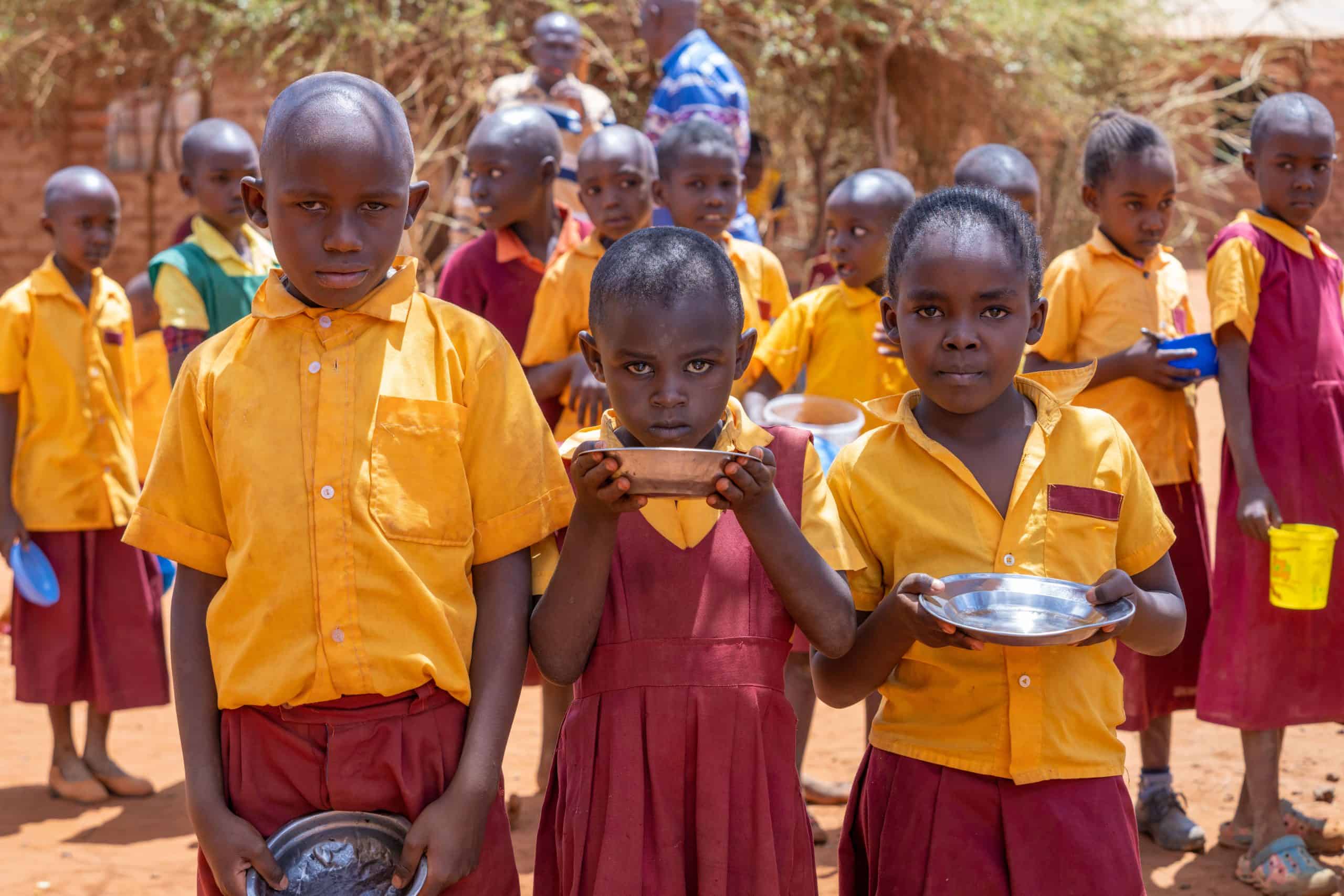
A hot meal at school does two things at once. It gives a child’s body and brain the fuel they need to keep developing. And it gives parents a reason to send their kids to school even during a crisis—because a guaranteed meal is one less thing to worry about feeding at home. Communities with strong school feeding programs see enrollment and attendance climb, even in years when household income has collapsed.
The Longer Game: Building Local Resilience
Here’s where the approach gets interesting. A school feeding program that just ships in food forever isn’t solving the underlying problem; it’s swapping one dependency for another. ADRA’s model is built to phase itself out.
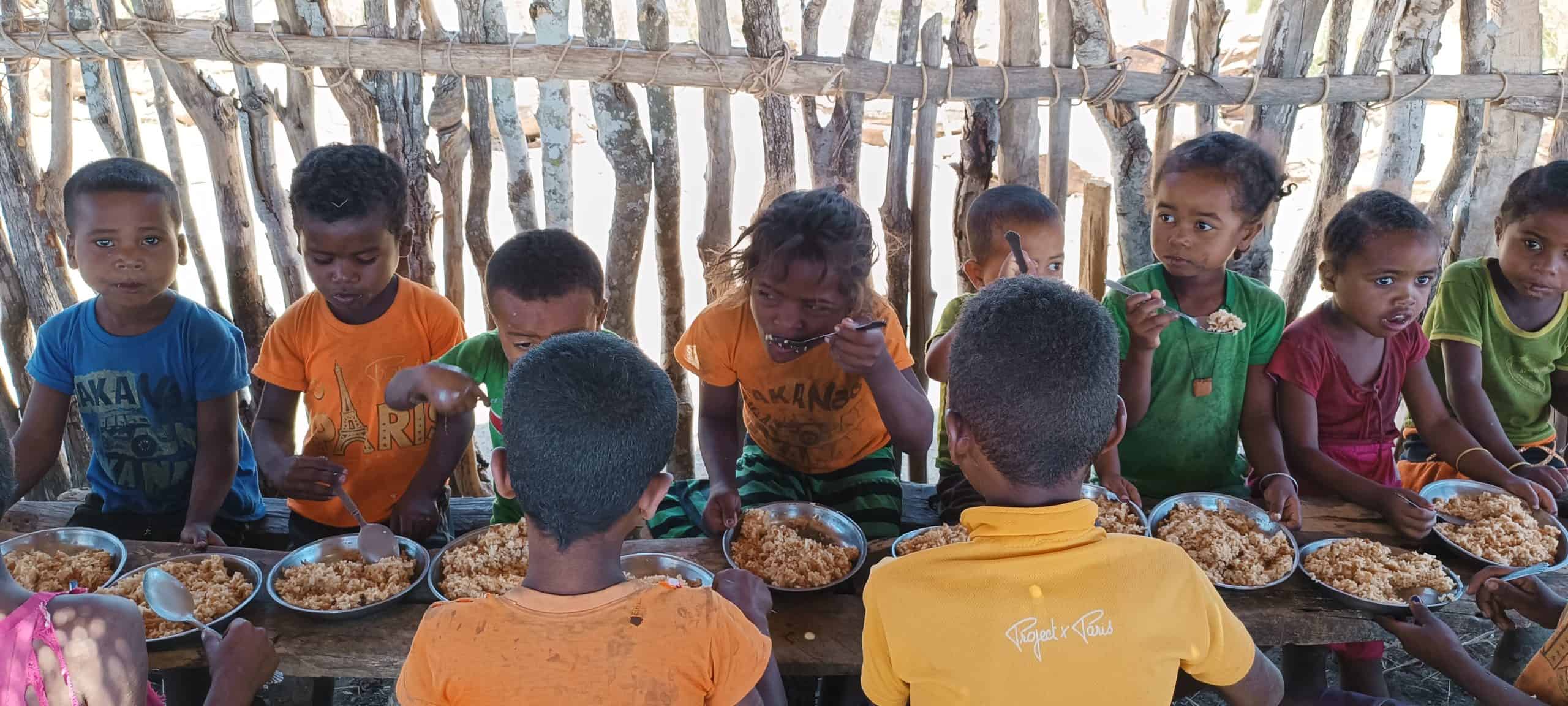
Take the School Feeding Initiative in Madagascar’s Ampanihy district, launched in response to El Niño-driven drought across the country’s south. The program currently reaches over 17,000 children across 103 schools. But the meals are only half the work.
ADRA also provides seeds, agricultural training, and water infrastructure so that schools and surrounding communities can eventually grow what they serve. That detail matters more than it sounds like it should: it means a child’s future stops depending on wheat prices in the Black Sea or fertilizer costs in Canada, and starts depending on soil that family already knows how to farm.
Droughts will happen again. Prices will spike again somewhere in the world. A program built on local production is built to survive that in a way that food shipped from abroad never will be.
There’s a bigger idea sitting under all of this. A hungry child isn’t just missing a meal—she’s missing the future she was supposed to get. That’s the case ADRA makes through Justice Begins at Childhood, our campaign built around one belief: protecting a child’s dignity isn’t charity, it’s justice. A school feeding program is what that principle looks like on the ground, one plate at a time. See the campaign.
The Meal That Changes Everything Else
A broken supply chain is a problem measured in shipping delays and commodity prices. A hungry child is a problem measured in a future that doesn’t get to happen—the student who never enrolls, the mind that never fully develops, the family that stays exactly as poor as the one before it.
School feeding programs work because they don’t wait for the global machine to fix itself. They meet a child exactly where the damage starts, and they stop it there. Feed a child consistently, and something changes that has nothing to do with calories: theconstant, quiet panic of survival switches off. Curiosity switches back on. A kid starts imagining what they might become instead of just getting through the day.
That’s the actual return on a school meal. Not just a fed child today, but a child who gets to stay a child. One who gets to sit in a classroom and think about something other than their next meal.
If you’d like to partner with ADRA to support students around the world and break the cycle of hunger, click here to learn more about how to give.
Perguntas mais frequentes
What is a school feeding program?
A school feeding program gives children a regular, nutritious meal at school, usually free of charge. Beyond nutrition, it keeps kids enrolled, gives parents a reason to prioritize schooling over labor, and often anchors broader community development work like farming and clean water access.
How does hunger affect a child’s ability to learn?
Chronic hunger forces a child’s body into survival mode, slowing brain development at the exact age it happens fastest. The result is often stunted physical growth and reduced cognitive ability—deficits in memory, language, and problem-solving that can be permanent if the child doesn’t get consistent nutrition early enough.
Why did food prices spike so sharply in 2022?
Drought cut yields in major growing regions at the same time pandemic-era shipping costs were already high. Then the conflict in Ukraine blocked Black Sea grain exports from two countries that together supplied close to a third of the world’s wheat, pushing global prices up within weeks.
How is ADRA’s school feeding approach different from typical food aid?
ADRA pairs daily meals with agricultural training, seeds, and water systems so communities can eventually grow their own food for the program. The goal isn’t ongoing dependency on shipped food. It’s a school and community that can feed its own kids, regardless of what’s happening in global grain markets.
How can I support a school feeding program?
You can support ADRA’s hunger relief work with a one-time or recurring donation, which helps fund school feeding, agricultural training, and the broader food security programs that keep communities resilient. Even a small, recurring gift adds up, and it helps make sure a child doesn’t miss a meal the next time a crisis hits.
What is ADRA’s Justice Begins at Childhood campaign?
It’s ADRA’s campaign to protect children’s dignity, rights, and futures from poverty, conflict, and displacement. School feeding is one concrete piece of that mission—proof that a child’s circumstances don’t have to decide their future. Learn more here.